Pearls have fascinated people for centuries with their natural luster and timeless elegance. Among the various types of pearls, the keshi pearl holds a special place, particularly in French Polynesia.
But what exactly is a Tahitian keshi pearl? Where does it come from, and what are its distinctive characteristics?
Let’s explore together the fascinating world of these little wonders of nature.
The Origin of Tahitian keshi pearls
The term “keshi” comes from Japanese and literally means “poppy seed.” This name refers to the small size of the first keshi pearls discovered in Japanese pearl farms in the early 20th century.
Keshi pearls originally appeared by accident during the pearl cultivation process. When an oyster rejected the nucleus implanted by the pearl farmer but continued to secrete nacre around fragments of pearl tissue, a nucleus-less pearl would form.
Long considered byproducts of pearl farming, keshi pearls are now sought after for their unique beauty and exceptional quality.
How is a Tahitian keshi pearl formed?
To understand how a Tahitian keshi pearl is formed, you first need to understand the basics of pearl farming.
During the implantation procedure, a technician inserts a nucleus and a piece of tissue from an oyster mantle into a pearl oyster. The goal is to stimulate mother-of-pearl production in order to create a traditional cultured pearl.
However, sometimes the oyster expels the nucleus while retaining the grafted tissue. This tissue then continues to produce mother-of-pearl, resulting in a pearl made entirely of mother-of-pearl. It is this characteristic that fundamentally distinguishes Tahitian keshi pearls from traditional Tahitian pearls.
The result is a seedless pearl made entirely of mother-of-pearl.
The main characteristics of Tahitian keshi pearls
An exceptional chandelier
One of the most remarkable qualities of Tahitian keshi pearls is their luster. Composed of layers of mother-of-pearl, they reflect light with an intensity that is often greater than that of many traditional pearls.
This deep luster gives them a particularly precious and elegant appearance.
Unique, irregular shapes
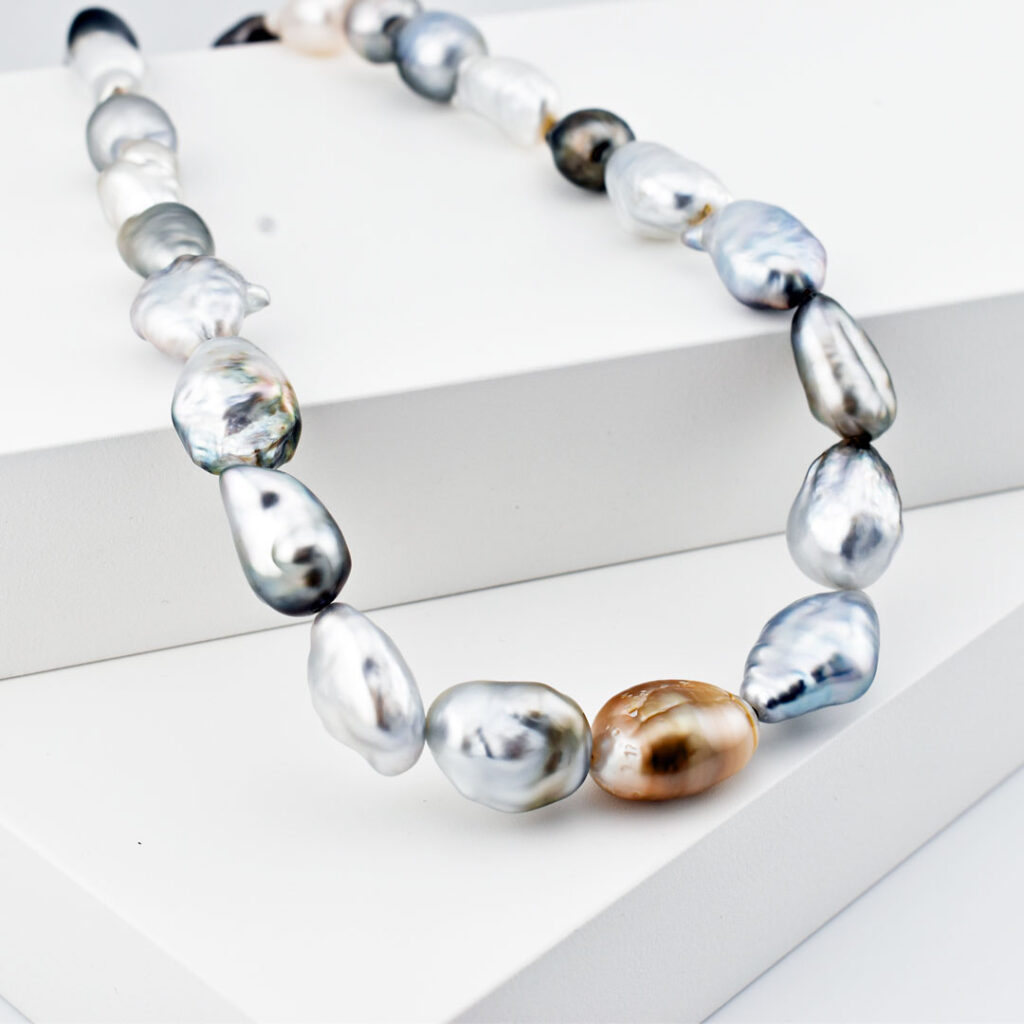
Unlike round pearls formed around a spherical nucleus, Tahitian keshi pearls develop free-form, organic shapes.
They can be:
- Baroque
- Elongated
- Flat
- Oval
- Petal-shaped
Every Tahitian keshi pearl is unique, which explains their popularity among jewelry designers looking for original pieces.
Keshi pearls are 100% mother-of-pearl
The complete absence of a nucleus is undoubtedly the most sought-after characteristic of Tahitian keshi pearls. This not only gives them remarkable luster, but also excellent durability when properly cared for.
Tahitian keshi pearls: a wide variety of colors
Tahitian keshi pearls come in a wide range of natural hues:
- Pearly white
- Cream
- Pink
- Silver
- Gray
- Pale green
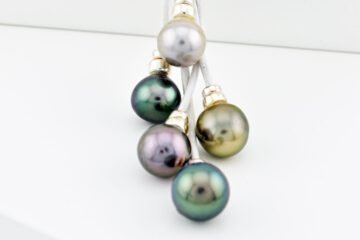
- Black with iridescent highlights
The color depends mainly on the species of oyster used and the environment in which it lives.
The different types of keshi pearls
Today, several types of keshi pearls are produced around the world.
Freshwater keshi pearls
Mostly from China, they come in a wide variety of shapes and colors. They are generally more affordable.
Akoya keshi pearls
Derived from the famous Japanese Akoya oysters, they are distinguished by their intense luster and their often smaller size.
Keshi pearls from the South Seas
Produced in Australia, Indonesia, or the Philippines, they are renowned for their generous size and their magnificent satin-like luster.
Tahitian keshi pearls
Native to French Polynesia, they feature exceptional dark hues ranging from silvery gray to peacock green and deep black.
Why are Tahitian keshi pearls so popular?
Tahitian keshi pearls are becoming increasingly popular for several reasons:
Their rarity
The formation of a Tahitian keshi pearl remains a relatively unpredictable phenomenon. This rarity contributes to their market value.
Their authenticity
Every Tahitian keshi pearl has a unique shape. No two are exactly alike, which enhances their exclusivity.
Their natural beauty
At a time when authenticity and imperfection are increasingly valued, the organic shapes of Tahitian keshi pearls appeal to a public seeking original and elegant jewelry.
How do you care for your Tahitian keshi pearls?
Like all pearls, keshi pearls require some special care:
- Avoid contact with perfumes and chemicals.
- Clean them with a soft cloth after each use.
- Store them separately from harder jewelry to prevent scratches.
- Avoid prolonged exposure to heat or sunlight.
Regular maintenance will help preserve their luster for many years to come.
Conclusion
The Tahitian keshi pearl is a true treasure of nature. Formed through an unusual process, it is distinguished by its entirely pearly composition, its exceptional luster, and its unique shapes.
Long considered a curiosity in the world of pearl cultivation, it has now become a symbol of natural elegance and authenticity. Whether used in a necklace, bracelet, or earrings, Tahitian keshi pearls add a refined and unique touch to all jewelry designs.
Choosing a Tahitian keshi pearl means choosing a rare product and establishing a direct connection to the lagoons of French Polynesia.
Discover COCOBLANC‘s creations in Moorea
Each Tahitian keshi pearl used by COCOBLANC is selected for its luster and character. It comes directly from the lagoons of French Polynesia.