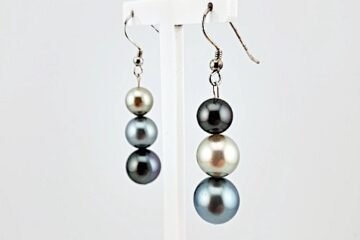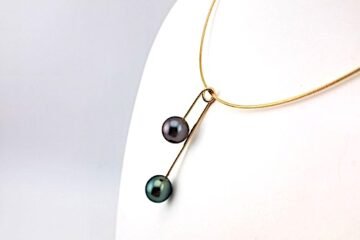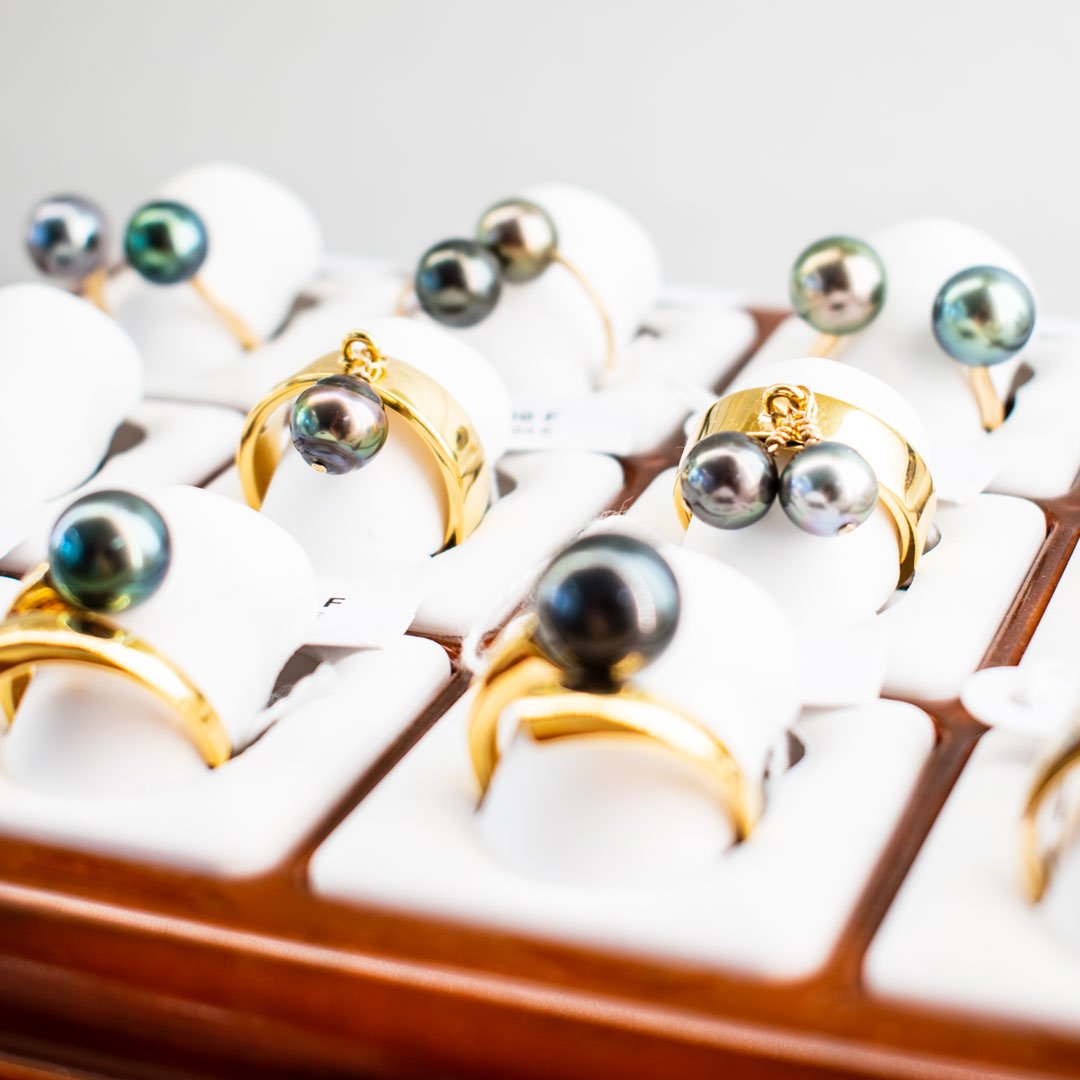
Tahitian pearls captivate with their deep colors and unique luster.
Sourced from the pristine lagoons of French Polynesia, they are among the most precious gemstones in the world.
But not all Tahitian pearls are created equal. So, how can you tell if a pearl is high-quality? What are the key criteria to consider before buying?
Here is the complete guide to understanding the true value of a Tahitian pearl.
An origin that already influences quality
Tahitian pearls come from the “Pinctada margaritifera” oyster, which is cultivated in the crystal-clear waters around Tahiti and the neighboring archipelagos.
The environment (as water quality, temperature or biodiversity) plays a fundamental role in pearl formation.
The 5 essential quality criteria
1. The luster
Luster refers to a Tahitian pearl’s ability to reflect light. There are different grades of luster:
- Exceptional luster (mirror-like effect)
- A very beautiful luster
- Average luster
- Low luster
The more intense the luster, the more valuable the Tahitian pearl.
2. The Surface
A perfect Tahitian pearl is virtually nonexistent. However, its quality depends on the number and visibility of natural irregularities on its surface.
- A clean and flawless surface: top-of-the-line quality
- A few visible flaws: this is considered standard quality
- Numerous irregularities: this is considered inferior quality
Surface irregularities may include:
- Small imperfections
- Natural streaks
- Or even growth marks
3. The shape
The shape has a significant impact on the value of a Tahitian pearl:
- Round: extremely rare and very expensive
- Semi-round or teardrop/pear-shaped: a good compromise
- Circled or baroque: irregular, artistic, and trendy
The less uniform a Tahitian pearl is, the more affordable it is… but also the more unique.
4. The size
Tahitian pearls are among the largest in the world.
- 8–10 mm: standard sizes that are most commonly found
- 10–13 mm: sizes that are more sought after
- 13 mm and larger: sizes that are rarer and therefore more expensive
The larger the Tahitian pearl, the higher its value (depending on the quality of the other criteria, of course).
5. The color
Contrary to popular belief, Tahitian pearls are not only black. They come in an exceptional range of natural colors:
- Deep black
- Peacock green (very popular)
- Silver gray
- Eggplant
- Blue…
The ideal color depends on personal taste, but certain rare shades—such as blue, pink, and champagne—increase the value.
The official classification of Tahitian pearls
In French Polynesia, pearls are classified according to a recognized system:
- TOP GEM: a pearl considered “perfect.” It has no surface imperfections and exhibits superb luster.
- A: a grade considered superior, with very few surface irregularities—that is, at least 90% of the surface is free of imperfections—and excellent luster.
- B: a few minor imperfections are possible, but at least 70% of the surface must be free of imperfections.
- C: the Tahitian pearl has a surface that is free of imperfections on at least 40% of its surface. On the remaining 60%, slight imperfections are possible.
- D: a more standard quality; the Tahitian pearl has slight imperfections on more than 60% of its surface.
Keep in mind that the grading of a Tahitian pearl takes into account its surface and luster.
Common Misconceptions to Avoid
“A black pearl is necessarily better.”
False => Quality depends on all the criteria we just mentioned.
“Most Tahitian pearls are generally perfect.”
False => Tahitian pearls most often have slight irregularities—some visible to the naked eye, others not—but they are all natural.
“The price of a Tahitian pearl depends mainly on its size.”
False => Its luster, surface quality, and color are often more important.
How do you choose a high-quality pearl?
Always prioritize the following first:
- The luster
- Surface quality
- Overall harmony
- The effect on your skin
Only then should you consider the size and color.
Conclusion
Buying a Tahitian pearl can be considered a real investment.
Understanding the quality criteria for Tahitian pearls is essential to making an informed choice. Every pearl from the lagoons of Tahiti is unique, but only some achieve excellence.
By considering the luster, surface, shape, size, and color, you’ll be able to recognize an exceptional Tahitian pearl… and choose the one that’s truly right for you.
Discover COCOBLANC‘s creations in Moorea
Every Tahitian pearl that COCOBLANC carefully selects is chosen according to the highest quality standards.